

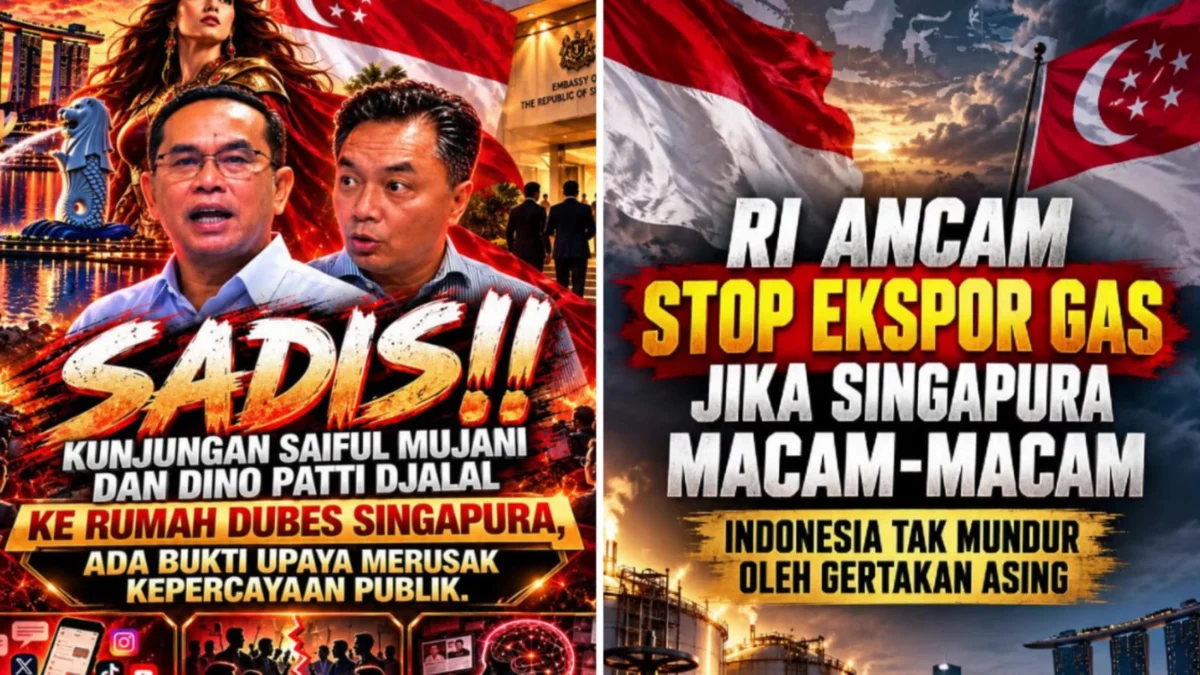
JustUpdateOnline.com – Jakarta, A sophisticated wave of disinformation has recently flooded social media platforms, aimed at undermining the relationship between Singapore and Indonesia through a series of fabricated narratives. Recent investigations into digital activity reveal that nearly 400 deceptive posts were circulated across TikTok, Instagram, X, and Facebook, garnering approximately 12 million views within a short window in late October.

The surge in misleading content appears to be a calculated effort to scapegoat Singapore for domestic issues in Indonesia. Among the most prominent falsehoods was a claim that Singapore’s Ambassador to Indonesia had hosted a clandestine meeting at his Jakarta residence with academic Saiful Mujani and former diplomat Dino Patti Djalal. The posts utilized inflammatory language, including historical slurs intended to paint the Indonesian figures as "servants" to foreign interests.
Both Dino Patti Djalal and Saiful Mujani have categorically denied that such a meeting ever took place, while Singaporean officials have labeled the reports as blatant disinformation. The timing of these attacks coincided with Dino’s public defense of Singapore against rumors of economic interference and Saiful’s research institute publishing data showing a shift in domestic political approval ratings.

The disinformation campaign also extended into the economic sector. Following a downturn in the Indonesian stock market linked to a potential downgrade by the global index provider MSCI, several social media accounts began baselessly accusing Singaporean investment entities, such as GIC and Temasek, of orchestrating the market decline. These accusations were amplified by high-profile figures and later weaponized by a network of "buzzer" accounts.
Digital forensic analysis suggests these activities were not organic. Many of the accounts involved were created on the same day, utilized identical templates and imagery, and published their content within seconds of one another. One specific narrative attempted to link Indonesia’s internal decision to reduce gas exports to a retaliatory move against Singaporean "interference," despite official statements citing domestic supply needs as the primary reason for the policy.

Security experts and regional researchers suggest that these tactics are often employed to deflect internal criticism by redirecting public anger toward a foreign "enemy." By utilizing nationalistic rhetoric, local political actors may be attempting to silence domestic dissent by associating critics with foreign influence.
Muhammad Faizal, a researcher specializing in regional security at the S. Rajaratnam School of International Studies (RSIS), noted that while some of the sentiment may arise naturally from the public, the high level of coordination points toward a deliberate strategy. He warned that such "cognitive warfare" serves to distract the populace and protect the government from scrutiny by targeting smaller neighboring nations.

As Singapore prepares to take on the ASEAN chairmanship in 2027, experts emphasize the need to maintain strong bilateral ties and resist the polarizing effects of digital propaganda. Maintaining a stable and prosperous relationship remains vital for the economic health of both nations and the broader Southeast Asian region.
